
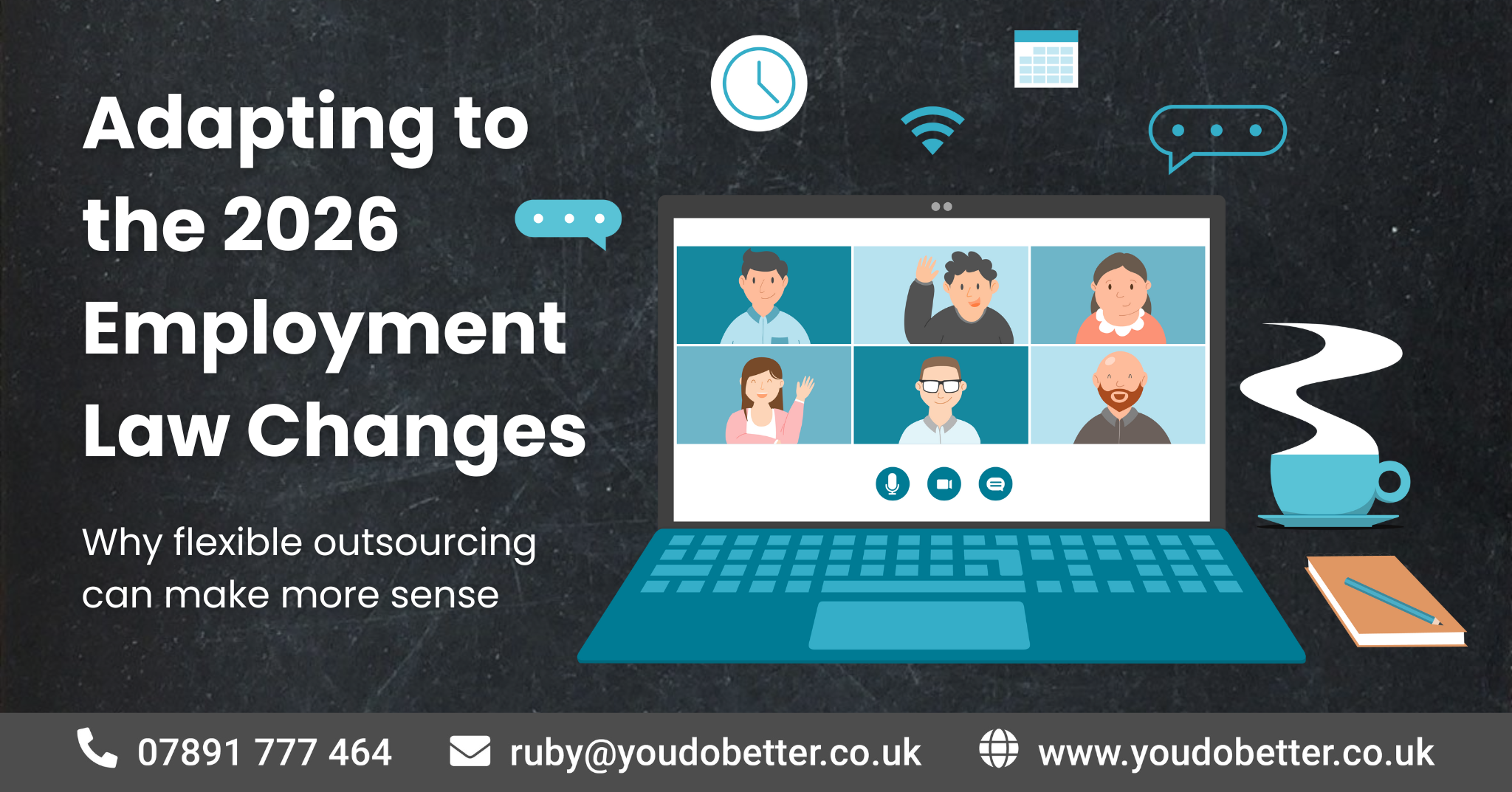
In 2026, major changes to UK employment law will reshape how businesses hire, manage staff and plan for the future. The new Employment Rights Bill and related reforms will introduce day-one rights for some employees, strengthen protections and increase potential liabilities for employers.
For many organisations, these adjustments bring extra challenges around staffing, flexibility and cost management. As a result, more businesses are reassessing their structures – balancing the benefits of hiring full-time employees (FTEs) with the growing advantages of flexible outsourcing.
Key legal changes to watch:
The government’s Employment Rights Bill Implementation Roadmap outlines when the new reforms will take effect:
- The Employment Rights Bill roadmap provides a full timeline of changes at gov.uk.
- From April 2026:
- The collective redundancy protective award will double, raising potential costs for employers who fail to consult properly (employmentlawwatch.com).
- Statutory Sick Pay will be reformed, removing the lower earnings limit and waiting period (tlt.com).
- Day-one rights for parental and paternity leave will come into force (deanwilson.co.uk).
- A Fair Work Agency will be established to oversee enforcement (osborneclarke.com).
- From October 2026:
- The government will introduce a ban on “fire and rehire” practices, making dismissal and re-engagement on new terms automatically unfair (clydeco.com).
- Stronger rules around workplace harassment and union access will take effect (kpmg.com).
- Employment Tribunal time limits will extend from three to six months in many cases (employmentlawwatch.com).
- Looking ahead to 2027:
- The qualifying period for unfair dismissal claims is expected to be removed (farrer.co.uk).
The official government overview of the Employment Rights Bill can be found at assets.publishing.service.gov.uk.
These reforms will strengthen employee rights but also add complexity for employers, particularly small and medium-sized businesses that rely on flexible staffing structures.
How flexible outsourcing can help:
With the cost and complexity of employing additional staff set to increase, outsourcing certain functions is becoming a practical solution. By using external professionals on an as-needed basis, businesses can:
- Access expert skills without adding headcount
- Avoid payroll and HR administration burdens
- Keep costs predictable and project-based
- Respond quickly to workload changes without risk of redundancy or dismissal claims
- Maintain focus on core business priorities
Flexible outsourcing gives organisations the ability to scale their operations up or down depending on need while staying in step with the changes in employment law..
Business insight
Mike Forrester, Chair of the Herefordshire & Worcestershire Chamber of Commerce, confirms: The 2026 UK Employment Rights Bill is expected to be implemented in stages from April 2026, October 2026 and 2027. It introduces significant changes aimed at enhancing worker protections, with a total annual estimated cost to businesses of up to £5 billion. The impact varies by business size, with smaller businesses facing disproportionately higher administrative burdens. The new legislation introduces a range of new obligations that SMEs will need to manage.
For small businesses are likely to face increased wage bill costs, a higher administrative burden managing new ‘day-one’ rights, more frequent flexible working requests and maintaining meticulous HR records for potential tribunal claims, where the maximum protective award and extended tribunal time is doubled.
Where a small business does not have its own dedicated HR team the cost of outsourcing this will need to be borne. All of the above is likely to cause hiring cautions, and may already be doing so. A greater use of traditional flexible, lower risk but potentially higher cost solutions such as HR, Temporary Staff, Marketing, IT and Finance can mitigate the eventual ‘day one’ right to protection from unfair dismissal as employers become more risk-averse when hiring new staff.
A balanced approach to resourcing
It’s important to recognise that many businesses will still choose to employ full-time staff, especially in roles where long-term continuity and in-house experience are essential. However, if increasing your number of FTEs doesn’t align with your structure, budget or growth plans, outsourcing can be a viable and effective alternative.
By blending internal roles with trusted outsourced partners, businesses can maintain both flexibility and stability, gaining access to specialist expertise without adding to ongoing employment responsibilities.
Expert insight
Ben Mannion, Director at Hewett Recruitment states: “As a recruitment business, we have observed first-hand how the impending Employment Rights Bill is already influencing hiring behaviours across a broad spectrum of organisations. The heightened caution among employers is unmistakable.
Many companies are re-evaluating their workforce strategies, with the anticipated increase in statutory protections, costs and potential liabilities associated with full-time employment prompting businesses to be wary of long-term commitments unless they are completely sure of them.”
We have seen a marked uptick in the use of temporary staffing solutions as a means of navigating this evolving landscape. Temporary recruitment offers immediate flexibility, allowing organisations to respond rapidly to shifts in demand without over-committing themselves. By opting for temporary hires, businesses can manage costs more effectively and ensure compliance, all while maintaining access to vital skills and expertise.”
Why businesses are turning to flexible outsourcing in 2026
- Aligns with changing employment regulations
- Keeps costs manageable and transparent
- Provides instant access to professional expertise
- Reduces risk of workforce disputes or restructuring
- Supports growth without long-term obligations
Ben concludes: “In summary, the trend is clear: as employment law reforms potentially introduce greater complexity and cost to permanent hiring, temporary / interim staffing is emerging as an essential tool for risk mitigation and business continuity. We anticipate that this cautious, blended approach to resourcing will persist as the ERB changes come into full effect over the next couple of years.”
The 2026 employment law changes will encourage businesses to think differently about how they work. Whether you choose to expand your in-house team or explore flexible outsourcing, both models can be effective. It’s about finding the balance that suits your organisation best.
Learn more about how outsourcing your marketing can support your organisation at youdobetter.co.uk.