

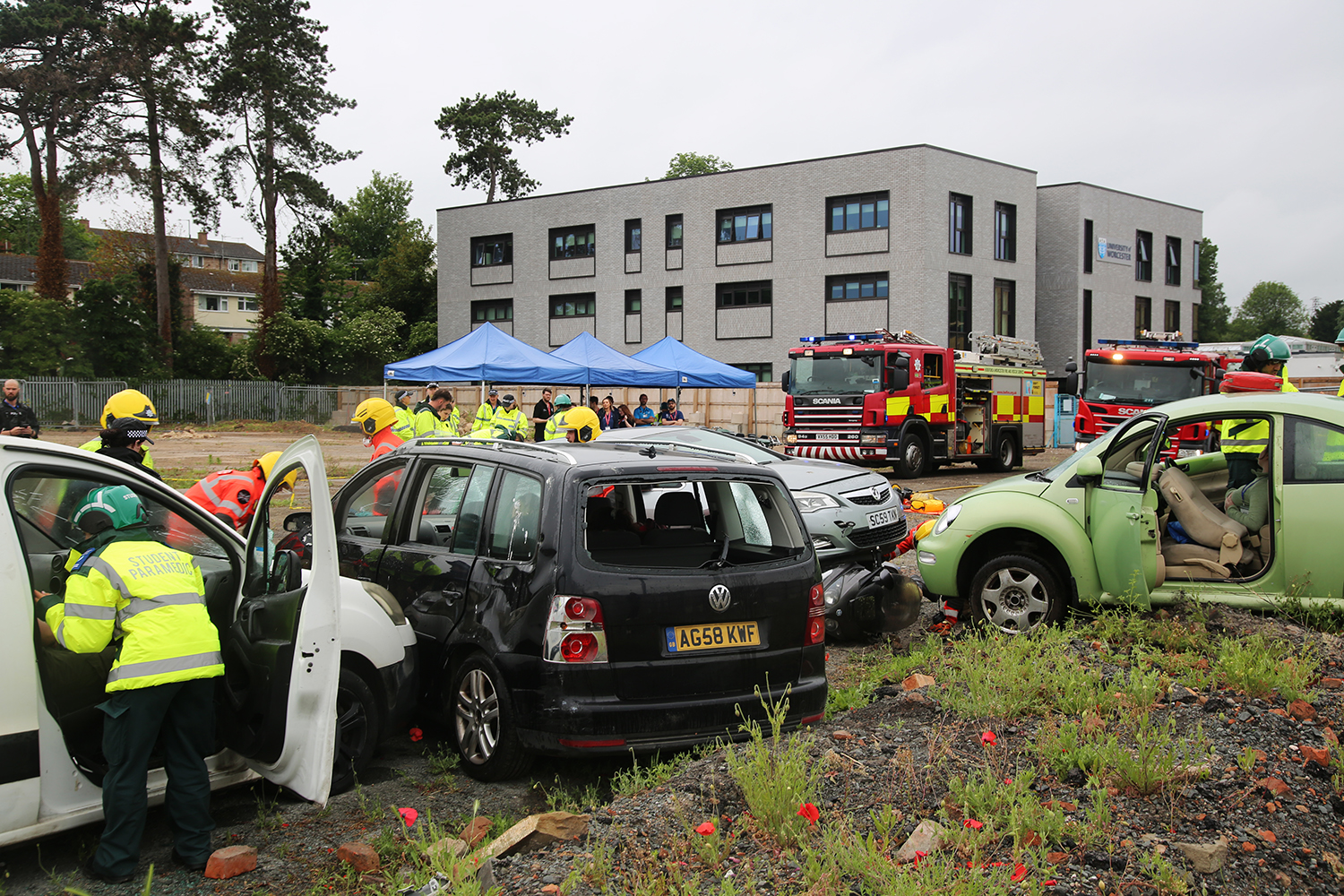
Students from across the University of Worcester took part in a large-scale emergency simulation in the city, working alongside frontline blue light services to respond to a staged multi-vehicle collision.
Policing, Medical and Paramedic Science students were involved in the exercise, which took place at the University’s Severn Campus. The scenario simulated a serious multi-car road traffic incident, with actors playing injured casualties trapped in damaged vehicles.
Crews from Hereford and Worcester Fire and Rescue Service took part in the simulation, and used heavy equipment to secure vehicles, remove doors and cut open windows to safely extract those involved.
Paramedic Science students treated casualties at the scene before transporting them to a mock Accident and Emergency ward created within one of the University’s healthcare buildings. There, Medical students assessed and treated patients as part of the exercise.
Policing students gained first-hand experience of managing and supporting a major incident, assisting emergency services and carrying out mock interviews with witnesses and casualties.
Phil Edwards, Lecturer in Policing, said: “This event has taken a lot of organisation, but it’s fantastic to see students collaborating across so many different disciplines, working together for the greater good. They’re getting first-hand experience of a real-world scenario, operating in a serious and pressurised environment alongside a range of organisations.”
“Having active-duty police and fire services here adds to the realism,” he added. “We work closely with these services, and the learning that comes out of this for all of our students is immense.”
“Ultimately, this kind of experience is about preparing all students for the realities of frontline work. It ensures they enter their professions with confidence, practical experience, and a clear understanding of how different emergency services work together in high-pressure situations.”
The simulation was designed to be as realistic as possible, with the casualty actors remaining in character throughout to create an immersive environment.
“When a simulation is as real as this one, it puts people into a moment that feels truly genuine,” Phil said. “People have to concentrate as if it were real, they have responsibilities and are working in a pressured learning environment that reflects what they’ll experience in their careers.”
Once casualties had been extracted from the vehicles, Paramedic Science students treated them at the scene before transporting them to a simulated Accident and Emergency ward, where Medical students continued their treatment.
Ruby Sale, third-year Paramedic Sciences Student said: “This has been really beneficial. As a student paramedic, it’s rare that you’ll be exposed to such a big incident, so this prepares us for what we could experience. Working alongside policing and medical students and the fire service has been really great, we get to see how they work and how our practice ties into it all.”
In the simulated Accident and Emergency ward, casualties were triaged, a waiting area was established and beds on the ward were occupied by the crisis actors.
Dan Eccles, second-year Medical student and member of the Worcester Emergency Medical Society, is one of the organisers of the event.
“For this event, we wanted it to be bigger, and to have more people involved than previous simulations,” he said. “We wanted to give students the feeling of what it’s like to be in a major incident, and it’s incredibly realistic.”
Dan continued: “Having these extra-curricular opportunities where we’re fully immersed is so beneficial. When we qualify as doctors we’ll work in emergency situations.”
Dan added that it was important to challenge students in a controlled environment. “We’re trying to find that sweet spot, where you’re not overwhelmed, but you’re not comfortable either. Finding that balance means when we qualify, we’re more prepared for these situations.”