
Over the years, I’ve spent a lot of time working with health and safety teams.
I’ve sat through briefings, workshops and leadership sessions, listening to experts discuss risk, compliance and prevention. And I’ve sometimes come away thinking:
“We’re focusing on what needs to happen … but not enough on how we make this real for people.”
I’ve also experienced first-hand the reality behind those conversations – being part of organisations where there has been a fatality at work, and seeing the impact it has. Not just on their family, but on colleagues, managers, and the health and safety teams leading the investigation.
It changes the atmosphere overnight. It brings into sharp focus what health and safety is really about.
Because no matter how robust your processes are, they only work if people understand them, believe in them, and feel confident acting on them.
The gap between policy and practice
In my day-to-day conversations with business owners, it’s clear that health and safety is taken seriously.
The all-important policies and procedures are in place, but they’re only part of the picture. Because safety isn’t just about what’s written down. It’s about what people actually do.
There can still be a gap between what’s in place and what actually happens. It’s often in that gap where things get missed.
Someone once said …
22 near misses before an accident
Whether the number is exact or not, the message behind it is simple. We shouldn’t be waiting for things to escalate before acting.
Near misses are opportunities to spot, say and change something early.
If they aren’t shared and acted on, those chances are lost. Not because people don’t care, but because it doesn’t always feel easy or part of the norm to speak up.
Make safety part of everyday conversations
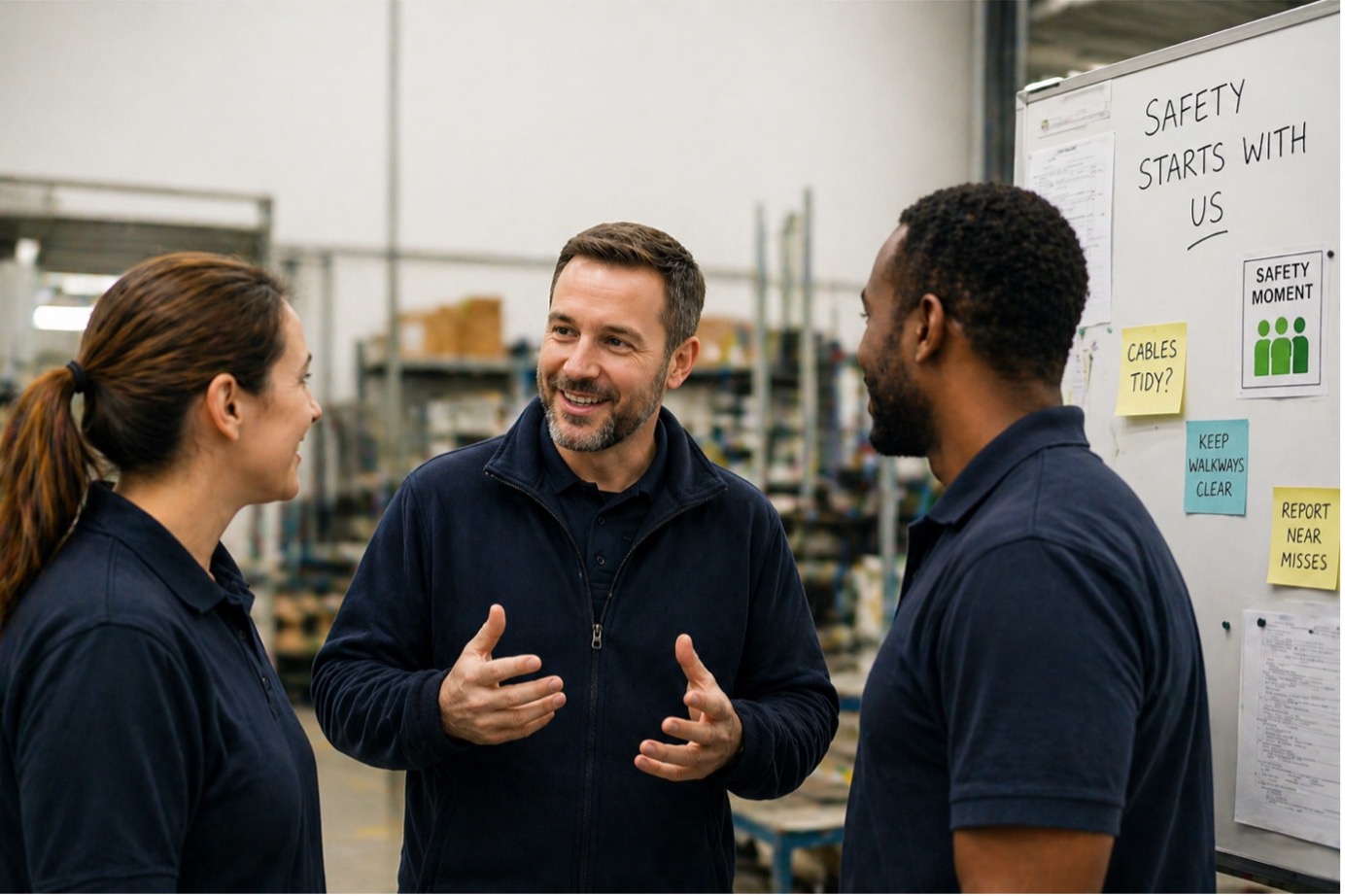
When I worked in the rail industry, we always had a “safety moment” at the start of every meeting – whether you worked trackside, in a station or in the office.
Someone would share something safety-related. It could be a near miss, an observation, or even a simple reminder about driving conditions or taking breaks. And it didn’t have to be work-related. Someone once gave a safety moment about using a ladder while decorating at home.
It brought health and safety to life and became a part of how we worked, embedding it into the culture.
Create space to reflect
Sharing information isn’t enough
After an incident or even a near miss, there is always a need to share information.
People want to understand what’s happened, what it means, and what happens next. In some situations, particularly when something is high profile or under investigation, what you can share may be limited.
But information on its own isn’t enough.
Creating space for conversation
People also need time and space to reflect, whether they were directly involved, or hearing about it as part of the wider team.
For some, that might be a team conversation talking through what’s happened and what it means for their work. For others, it might be a one-to-one conversation, especially if they’ve been more closely involved.
Supporting people in different ways
And where support is needed, it’s about making sure people know where to go, whether that’s speaking to a manager, a colleague, or accessing available support.
Good communication helps create that space. It makes it easier for people to ask questions, share concerns, and support each other.
It’s not just about understanding what’s happened. It’s about helping people process it and feel supported in what comes next.
And making safety relevant to everyone – whatever their role – is a big part of that.
Small actions shape culture
Start with simple actions
The most effective safety approaches I’ve seen aren’t about awareness – they’re about action.
- Encouraging team members to identify and discuss one potential risk during meetings
- Sharing a quick “near miss” or lesson learned
- Making one small improvement to how you work
On their own, these might feel small. But over time, they build awareness, confidence and habit.
Making safety relevant for everyone
I saw this in practice in a food manufacturing business I worked in, where safety was a clear priority on the shop floor but felt more distant in the office.
To change that, we introduced office safety tours – small groups walking around the office, spotting potential hazards.
Those taking part wore hi-vis vests to signal they were carrying out a safety tour. At first, it felt a bit uncomfortable – both wearing the jackets in an office environment and asking colleagues to move things like boxes or tidy cables.
But that quickly changed.
People started to notice things they’d previously walked past and talk about them. Over time, it became the norm.
How this becomes part of everyday work
And that’s what shapes culture – “how we do things around here.”
Health and safety will always need structure and processes. But culture is what determines whether people speak up, take shortcuts, or look out for each other.
And it’s shaped every day by communication – what’s said, what’s encouraged, and what people notice.
Ultimately, it’s about people and making sure everyone goes home safe, every day.
How I can help
If you’re not sure where to start, take a moment to reflect on your current approach.
- Are people regularly talking about safety?
- Do they feel confident raising concerns?
- And is it something that feels part of how we work day-to-day?
Keep it simple. Start a conversation, share a near miss, or take a fresh look at your working environment.
If you’d like to sense-check how your internal communication is supporting your approach to health and safety, I’d love to hear from you.
You can contact me on 07929 939683 or via email at [email protected].