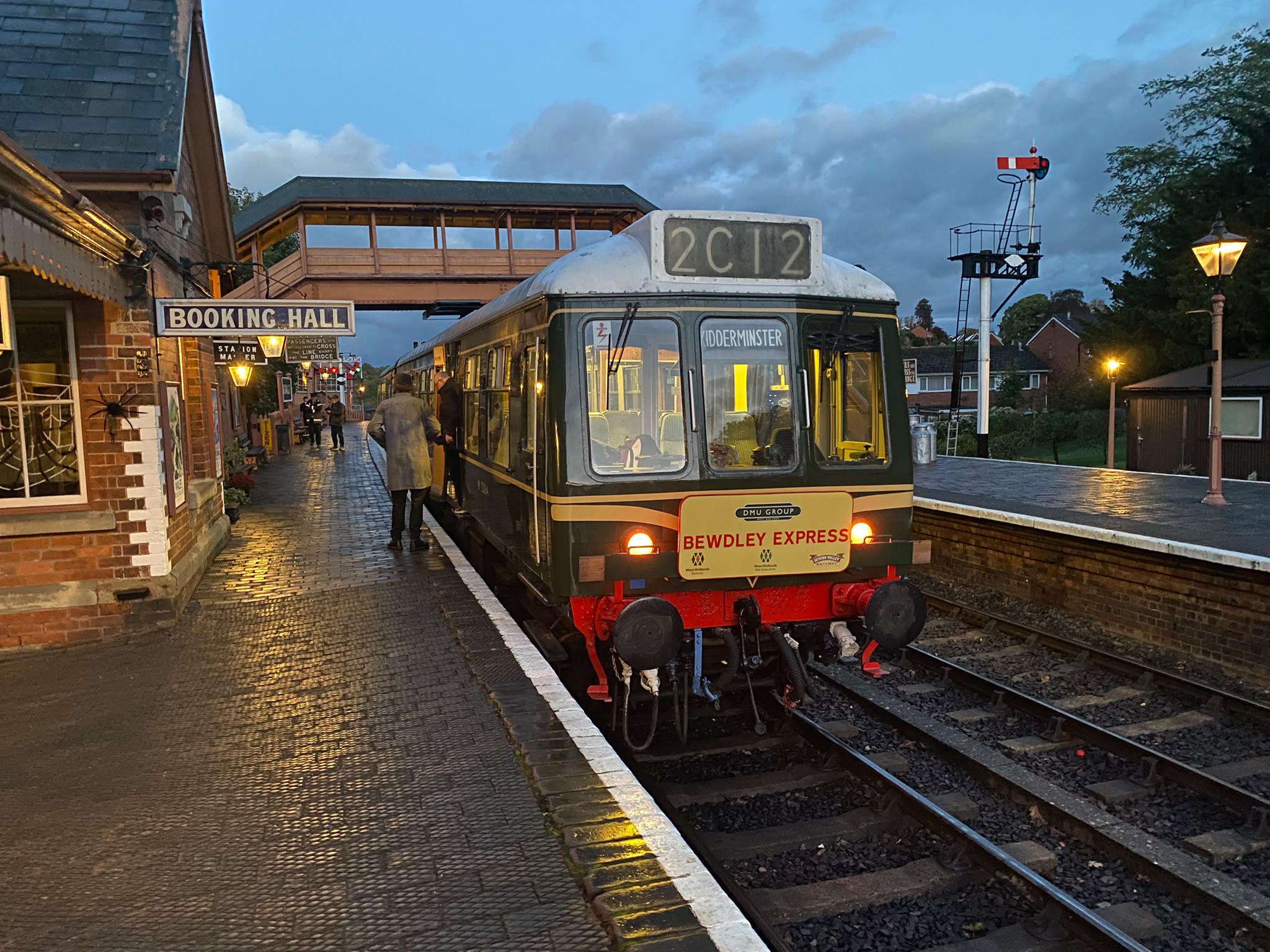
The Severn Valley Railway (SVR) has completed its eight-week Bewdley Express trial, with more than 1,000 passengers using the service to connect Bewdley with the UK’s main line rail network. The last of a total of 96 trial services arrived at Bewdley at 7.02pm on Thursday 22 October.
Running on Tuesdays, Wednesdays and Thursdays, the service offered two early morning connections from Bewdley to Kidderminster, linking with main line trains towards Birmingham and beyond, and two evening return connections. Primarily aimed at commuters travelling to work in Birmingham and Worcester, the service also attracted passengers making journeys to a wide range of destinations such as London, Plymouth and Glasgow.
The trial brought together the SVR, West Midlands Railway (WMR) and the West Midlands Rail Executive (WMRE) to explore how heritage railway infrastructure could help improve modern rail connectivity. It offered people in Bewdley and the surrounding area an alternative to travelling by car, opening up new opportunities for work, education and leisure.
The service also offered a unique experience: passengers could travel on a main line ticket on board the SVR’s heritage trains between Bewdley and Kidderminster, hauled by both steam locomotives and heritage diesel power. The SVR used several steam locomotives alongside its diesel multiple unit (DMU) during the trial, demonstrating how heritage railway assets could play a role in connecting local communities with the wider rail network.
Gus Dunster, the SVR’s chief executive officer, said: “We end the trial with a smile on our faces and a tremendous sense of pride in what we’ve achieved. It has been so rewarding to provide a service that has made a real difference to people in Bewdley and the surrounding area, and to see passengers taking the opportunity to use it.
“I’m immensely proud of the way the SVR, WMR and WMRE have worked together to make this happen. It has been a genuine partnership, with everyone bringing their expertise and commitment to a shared ambition. The trial has shown what can be achieved when heritage and main line railways work closely together.
“The SVR’s part in delivering the service was provided largely by our volunteers, many of whom took on very early starts and late finishes to make the timetable work. Their dedication, professionalism and enthusiasm have been outstanding, and I’d like to thank everyone who played a part.”
As the eight-week trial came to an end, passengers spoke of the difference it has made to their commutes.
“I’m reliant on public transport because I don’t drive,” said Lisa. “Normally I’d have to do a five-mile trek on my bike to Kidderminster to get a train to Birmingham. This has given me much more accessibility to commute to work. I’ve even written to the Minister of Transport to say what an enormous asset it is.”
David added, “It’s been pretty good, I’ve used it most days actually. I normally drive to Kidderminster, but this has been much better. Hopefully they continue it.”
The trial was designed to assess passenger demand and explore whether a regular service linking Bewdley with the wider rail network could be viable in the future. While more than 1,000 passengers used the service, no decision has yet been made about whether it could become permanent.
Any next steps will require careful consideration of the trial’s findings, alongside a range of operational and other factors. This will be a decision for the partners to take together, and the process is likely to take some time.
Gus added: “The trial has given us invaluable information and data, as well as demonstrating to potential passengers what is possible. There is still a great deal to consider before we can say whether this service could become a permanent fixture, but we have made an important start.
“We are immensely grateful to everyone who travelled on the Bewdley Express and helped make the trial a success. Whatever happens next, we can be proud of what we have delivered together and of the possibilities it has opened up for the future.”