

Local Skills Improvement Plans (LSIPs)

Funded by UK Government and led by designated Employer Representative Bodies (ERBs), LSIPs articulate local employers’ skills needs and the priority changes required in the local area to help ensure post-16 technical education and training provision is more responsive and flexible in meeting local labour market needs. The Herefordshire & Worcestershire Chamber of Commerce is the designated ERB for Worcestershire and supports the delivery of the Herefordshire LSIP on behalf of Shropshire Chamber of Commerce, the designated ERB for the Marches area.
Minister for Skills, Baroness Jacqui Smith says:
“Local Skills Improvement Plans (LSIPs) are critical for developing the skilled workforce Worcestershire needs. I’m delighted that the second wave of LSIPs is currently underway and I encourage businesses to engage with Lauren Ashford to articulate their skills needs and work with the local skills providers, including colleges and local universities, to develop solutions to address them.”
The British Chambers of Commerce’s latest report, Delivering Growth: Four Years of LSIP Impact, demonstrates the positive impact of employer-led Local Skills Improvement Plans across England. The report highlights how LSIPs are helping to align skills provision with employer needs, support economic growth and create new opportunities for learners and businesses.
Worcestershire LSIP
This project strengthens collaboration between employers, educators, and training providers to better meet business needs and explore new ways of working.

What are the priorities for the Worcestershire LSIP over 2026-2029?
- Health & Social Care – building a strong pipeline of skilled workers to meet growing demand.
- Construction – developing the workforce needed for housing, infrastructure and low-carbon construction.
- Manufacturing & Engineering – strengthening skills to support business growth and innovation.
- Digital & Employability Skills – equipping people with the workplace and digital skills needed to succeed.
- Business Resilience – supporting leadership, management, workforce planning and Net Zero readiness.
How Can You Help?
We want to hear from Worcestershire businesses about your experiences of recruitment, skills gaps, and workforce development. You can also join one of our five LSIP Priority Working Groups to help shape solutions, share best practice, and influence skills development across the county. Your insight will help keep employers at the heart of Worcestershire’s skills agenda and support a more responsive local skills system. To get involved or find out more, contact Lauren Ashford at the Chamber of Commerce.
Marches LSIP
What is the Marches LSIP?
The Marches Local Skills Improvement Plan (LSIP) 2026–2029 sets out current and future skills priorities for Herefordshire, Shropshire, and Telford & Wrekin. It supports employers, education and training providers, local authorities, and partners involved in post-16 technical education, workforce development, and employment support. Rather than covering every sector, the Marches LSIP focuses on a small number of sectors that are important locally, face skills shortages in whole or in part, and offer employment at scale, making them central to the local economy. The business voice across the Marches is central to this: without employer feedback, decisions are based on assumption rather than fact. Speaking up drives change, so taking action is vital.
Find Out More
Visit the Marches LSIP website here | General Enquiries: [email protected]

Testimonials
“Being involved with the Local Skills Improvement Plan has been genuinely worthwhile. What stands out most is how rare it is for employers to have a real, direct voice in shaping local skills provision, and the difference that voice makes when it is properly heard.
I lead a group of care businesses across the Midlands and West of England, where workforce is our biggest challenge. Too often, training has not reflected what care employers actually need or the reality of the roles people are being prepared for. The LSIP changes that by bringing employers to the table and asking what local businesses genuinely need from the people entering and progressing in the workforce.
The benefits are clear. Businesses gain a stronger pipeline of people with relevant, practical skills. Learners receive training that leads to real career opportunities. And skills investment is better targeted to support sectors where it will have the greatest impact.
What I have valued most is that the work is grounded in listening. Bringing employers, providers and learners together is not always easy, but it creates the kind of collaboration that leads to trusted, effective skills provision. Getting local skills right is fundamental to the future of our businesses, our communities, and the people who rely on the services we provide.”
“As a construction business based in a relatively remote location, recruiting skilled people has always been a challenge. We understand the full spectrum of skills our industry needs and are committed to developing future talent, offering opportunities ranging from work experience placements through to degree-level apprenticeships. Whether apprentices choose a quantity surveying, chartered surveying pathway, or a construction project management pathway, we provide them with the practical experience and industry knowledge needed to build a successful career in quantity surveying and project construction management where there are a known shortage of skilled people.
We also recognise how important it is for employers to engage with schools, colleges and training providers to help shape the future workforce. Being part of the LSIP Construction Skills Group will be incredibly valuable – making it much easier for us to connect with local colleges, understand the training opportunities available, and influence the development of skills provision to better meet industry needs. We would strongly encourage other employers to get involved with the LSIP. It will provide a genuine opportunity to work collaboratively, address skills challenges, and help create a stronger pipeline of talent for the future.”
LSIP Governance
The development of the Worcestershire LSIP was overseen by the 2023–2026 LSIP Board, which provided the primary governance mechanism to ensure that the plan remained employer-led, evidence-based, and responsive to local economic needs. Throughout the development process, the Board served as the principal forum for strategic oversight, providing direction, scrutiny, and constructive challenge.
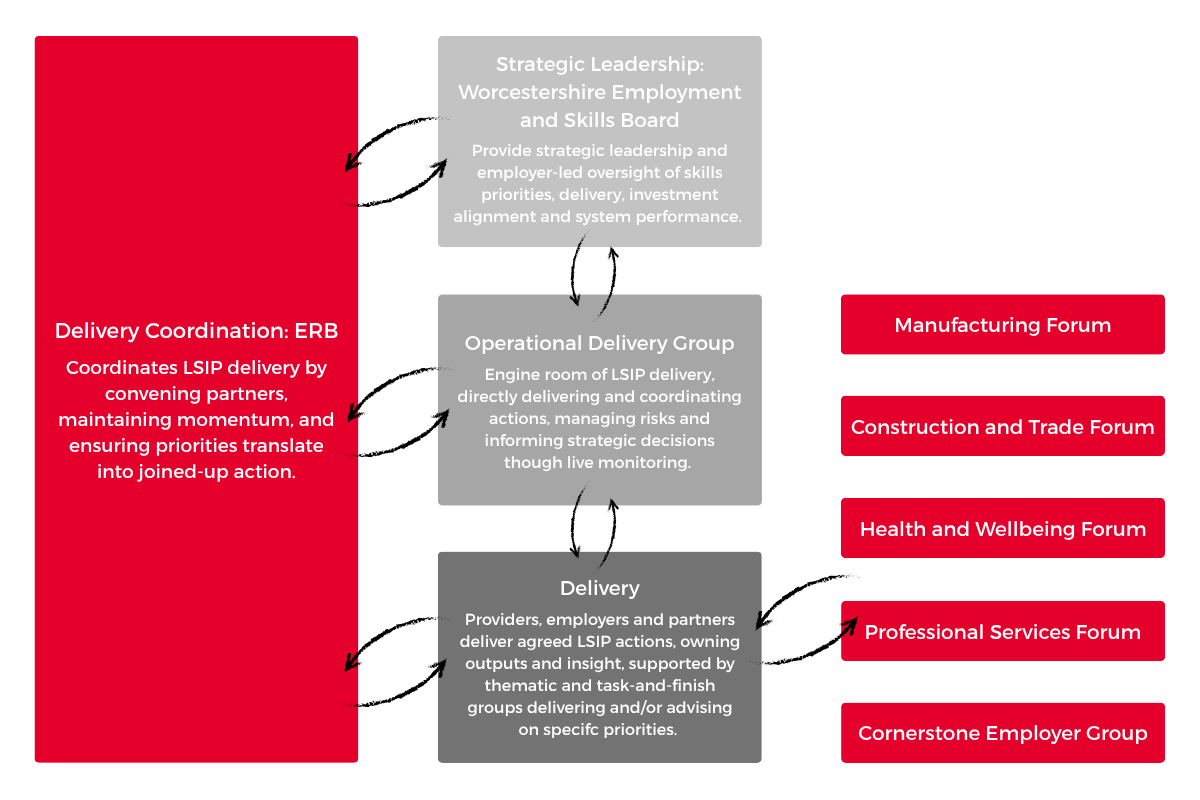
As the LSIP moves into its delivery phase for 2026–2029, an evolved governance structure has been agreed to strengthen coordination, performance monitoring, and alignment with wider skills system governance across the county. This revised governance model is designed to support effective implementation, ensure clear accountability, and facilitate ongoing collaboration between employers, education providers, and strategic partners.
The proposed governance model is summarised in the following graphic.
Conflicts of Interests Policy
Become a Chamber Member!
Contact our Chamber Membership team to find out how we can help your business.